Tuesday, December 14, 2010

The African Queen

My dad’s first boat was a “deadrise”, the kind of traditional workboat used by watermen on the Chesapeake Bay. It was a 23 foot wooden boat. The original inboard engine had been removed and a 4 cylinder Homelite outboard had been installed. The boat was old and beat up and clunky. Most of all, it was slow. My brother and I called the boat the “African Queen”, a reference to Humphrey Bogart’s clunky boat in the movie The African Queen.

One morning my dad, my brother Ken, and I left on an overnight trip down the river. We were headed to a place called Scotland Wharf. It would be a 2 day round trip. Around lunchtime on the first day, the engine died. We checked the fuel gauge; it was on “E”. We weren’t worried; we had two fuel tanks and the other tank was full of gasoline. We broke out some snacks and had lunch.

Why did we think this trip was going to be smooth? Nothing we did ever went smoothly.

After lunch we tried to start the engine. We connected the second fuel tank to the outboard and we cranked the engine. And we cranked some more. We waited in case the engine was flooded, and we cranked again. We cranked until the battery was dead.

Fortunately we had another battery! The engine had a bad charging system and wouldn’t charge the battery. So as we cruised down the river we were continually depleting the battery. During the day this wasn’t so bad, but at night we had to turn on the navigation lights, and battery life became an issue. So we carried 2 batteries.

We connected our backup battery. With a fresh battery the engine still wouldn’t start.

“Wait a second” I said. “Let’s pull the cover off the engine. I want to look at the distributor.” I had become suspicious that the points had closed up. If they had, there would be no high voltage for a spark.

With the distributor cap removed, I watched the distributor points while my dad cranked the engine. I was incredulous when the distributor rotor didn’t spin. The only possibility I could think of was a broken distributor shaft.

“Big trouble,” I thought. But we had tools with us, so we pulled the distributor out of the engine. The distributor shaft was really two shafts connected by a nylon coupling no bigger than a postage stamp, and that coupling had sheared.

We were drifting with no engine power. The depth gauge read 90 feet. And we were in the shipping channel. It was at this point that I looked behind us and saw a large freighter coming around a bend in the river and bearing down on us. The freighter was too big and too close to stop, and it couldn’t go around us in the narrow channel.

We had no paddles or oars, but we grabbed a couple of loose boards that happened to be lying in the bilge and we paddled furiously toward shore. Our efforts and the current brought us close to shore where some men were working on a house. Seeing our predicament, they threw us a line and hauled us into shore.

The men tried their best to help us. One even loaned us his car so we could look for a replacement part, but we had no luck finding anything useful. So one of the workmen took his power saw and cut off the end of a wrench so that we could make a replacement coupling. We took the little piece of steel back to the boat and, using a small file, we began to work on it, shaping it to replace the nylon coupling. It took hours of filing on that piece of hardened tool steel to make it fit.

There were other stories on that trip. The James gets fairly wide close to the bay. Nightfall found us chugging along in our small boat, running the engine and navigation lights from a single well-used battery, staring at the large ships around us, reading a navigation chart by a dim light bulb and trying to figure out answers to “where are we?” and “where are we going?” and “how do we get there?”. We made it to Scotland Wharf, but while we were getting gas the tide went out, and suddenly the African Queen was aground in the shallow water.

Eventually my dad sold the boat. I was at the marina the day the new owner had the boat pulled out of the water so that its hull could be scraped and painted. The marina guys got the boat onto a trailer, which they pulled up the boat ramp with a tractor. But the trailer wasn’t hitched properly to the tractor. When the tractor got to the top of the boat ramp, the hitch parted and the trailer, with boat, went flying down the ramp to the water. Boat and trailer crashed through part of a dock and a handrail. Suddenly the boat was drifting out with the tide with no one aboard. The marina guys retrieved the boat, but after the impact with the dock, the hull was never again watertight and the bilge had to be pumped constantly to prevent it from sinking.

Which, eventually, it did.

Monday, December 13, 2010

Biker Chick

I don’t remember her name, but in my mind she will always be “biker chick”.

I first saw her one night standing with her thumb out on a corner of a busy intersection in San Francisco, and I stopped and offered her a ride. She was in her early twenties, attractive, with blond hair, wearing jeans, work boots, and a denim jacket over a halter top. She sat behind me in my camper van on a little sofa. She was quiet. I stopped at a convenience store and bought a box of donuts. As I pointed my van back onto California route 1, I removed a donut for myself and passed the box to her. A few minutes later I looked behind me and saw her lying down, asleep. The donut box was empty. She must have been hungry and exhausted.

I was hoping to make it to Big Sur that night, but I was tired, too. The highway was dark, and I found a place where I could pull off the road. I quickly fell asleep.

The next day my hitch-hiking passenger was more talkative. She was a “biker chick”, the girlfriend of a biker. She had a four year old daughter in Florida that she missed and she was on her way there to see her. We talked all the way to Los Angeles.

It was late afternoon when we got to L.A., and I pulled my van off the road and into a parking area next to a public beach. I wasn’t sure what I was going to do next, and while I stood on the beach and pondered my next step, my passenger got out of the van, walked to the edge of the highway, and stuck out her thumb. Two minutes later she had found a ride and was gone.

Florida was three thousand miles away, and I felt some regret that I let her slip away so quickly. I wasn’t responsible for her but, even so, I felt I should have taken her at least part way home. I’ll never know what happened to her, but I’ve always hoped she made it home safely, back to her little girl.


Bixby Creek Bridge, about 14 miles north of Big Sur

400px-Bixby_Bridge_(2)

Sunday, December 12, 2010

Hot and Spicy

In another place and time, I often stopped at a neighborhood Chinese restaurant on the way home from work. The restaurant served hot pepper sauce with their spicy dishes. The sauce contained ground peppers in oil and was very spicy hot. (I don’t know what kinds of peppers were in it. They appeared to be toasted dark brown then ground and combined with the oil.)

The first time I tasted the pepper sauce, it felt like an atomic fireball went off in my mouth. I could tolerate only a small amount of it. But after a few years of eating it weekly, it became quite tame. I got it with every meal and spooned it onto everything. The restaurant owner knew I liked it and she began adding it to everything I ordered. Even fried rice had hot pepper sauce in it. That didn’t stop me from spooning even more on. I loved its flavor as well as its hotness.

I also loved Mexican food. A local Mexican family owned and operated several restaurants called El Rodeo. Sometimes I would stop in and have dinner at one of their restaurants. Upon sitting down, the first thing that happened was a waiter would bring a basket of corn chips and a bowl of red, tomato-based salsa and place them in the center of the table. That was an appetizer while the food order was being prepared. The salsa was supposed to be hot and spicy, but because of my Chinese pepper addiction, it tasted fairly bland to me.

One night I was in El Rodeo with a friend who was, like me, a hot pepper sauce addict. We both lamented the lack of hotness in the salsa. On an impulse I asked our waitress if she had anything hotter. She said, “No.”

So I said, “Come on now, you’re a Mexican family, you eat here in the restaurant and this is the hottest salsa you have? I don’t believe it.”

She admitted, “We do have something hotter. But it’s too hot for you.”

Too hot? Bring it!

She brought me a bowl of green salsa. Green, like a jalapeño! It even looked hot. I dipped a chip in it, and with just a slight amount of trepidation, I popped it into my mouth. Hmmm … not bad. It was definitely hotter than the regular, red salsa. My friend and I continued our conversation as we dipped chip after chip into the hot, green salsa.

Eventually hot peppers became something that a meal seemed incomplete without. It’s surprising that a person can adapt to, and even savor, something that at first is so painful. The brain learns to re-interpret that fiery sensation on the tongue as something that is as essential as table salt and black pepper.

On the other hand, if humans lacked that ability to adapt, this would be an awfully painful world. I wonder how many painful things I’ve adapted to … adapted so well that I’ve become comfortable living with them.

Saturday, December 11, 2010

HIgh and Mighty Factoid

I thought this was a stunning bit of irony.

In 1954 a movie was released called The High and the Mighty. It was a good movie with a memorable score that won an Oscar. The movie was about a passenger plane, a Douglas DC-4, that was carrying passengers on a flight from Honolulu to San Francisco when it experienced an engine fire. The crew thought they would have to ditch the plane into the Pacific Ocean, but with great skill and much luck they were able to land the plane in San Francisco with less than 30 gallons of fuel remaining. In the exterior and daylight flying sequences of the film, the plane used was a DC-4 passenger plane owned by carrier Transocean Airlines. The plane was named The Argentine Queen and had been the personal aircraft of Juan Perón, three-time President of Argentina. Transocean Airlines director of flight operations Bill Keating did the stunt flying for the movie.

A decade later, in 1964, the very same airplane used in filming the movie – The Argentine Queen – was carrying passengers on an overnight flight from Honolulu to Los Angeles when 8 hours into the 11 hour and 40 minute flight, the pilot radioed that the plane had an engine fire and might have to ditch. The pilot reported his position as 700 miles west of San Francisco. Unlike the fictional flight, on this flight luck ran out for The Argentine Queen. The U.S. Coast Guard searched for 5 days, but the plane and its passengers were never found.

Friday, December 10, 2010

Grace Potter

I wanted to post a video of Grace Potter and the Nocturnals, but while searching Youtube I found this video from 2007: some great musicians playing Neil Young’s Cortez the Killer. This is an awesome performance! Musicians include Grace Potter, vocals and keyboard; Joe Satriani, guitar; Willy Waldman, trumpet. (And if you like food, be sure not to skip the video at the bottom of this post.)

Cooking with Grace Potter!

How many recording artists record cooking videos? (For HD click the link and select 720p and full-screen.)

Part1:
Grace Potter makes an Apple, Pepper Jelly, Cheddar Grilled Cheese Sandwich. It really does look good … though I’m not sure about adding white truffle oil. Isn’t a grilled cheese supposed to be a cheap sandwich?

Part 2:
Grace makes a Hot Habanero Mexican Delight. It looks scary hot!

Thursday, December 9, 2010

Montana

It was night and I was about 500 miles from Montana when I picked up a hitchhiker. I drove on toward Montana and we talked. He was from Montana and that’s where he was headed. He was going home and I could get him part way there. There were thunderstorms ahead of us; I could see heat lightning on the sky but it was far away. I had already driven many hours and soon realized I was too tired and sleepy to drive; I needed a break. He offered to take over driving. By then, we had talked enough that I had a good idea of what kind of person he was. I pulled the van to the side of the road, and I moved to the sofa behind the driver’s seat, and my hitchhiker acquaintance took over driving. For a while, I lay on the sofa and looked through the windshield, watching the heat lightning play across the dark sky ahead of us. The next thing I knew, I was waking up. It was morning and we were in Montana. I dropped off my hitchhiker, now hundreds of miles closer to his destination, and I drove onward.

On that trip west, I drove to many places in Montana. The hottest was Helena. The van had no air conditioner and the August sun through the van’s windows was merciless. The most beautiful place was Glacier Park in northwest Montana near the Canadian border. It was picturesque with lots to see and do. And if a roadside attraction called the Montana Vortex near Columbia Falls wasn’t the weirdest place, it wasn’t for lack of trying.

My trip was east to west so eventually I had to drive over the Rocky Mountains. There are interstate highways, like I-90, that cross the Rockies, but I didn’t take an interstate highway. I took a small highway over the Rockies. It was scenic but steep and laden with switchbacks. I was amazed to see people pedaling bicycles in the opposite direction. Think of the strength and stamina it requires to pedal a bicycle over a mountain range.

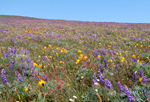
At the top of the pass through the Rockies I pulled my van off the road. Beside the road was a vast and level mountain meadow. There were no trees here; I was probably above the tree line. However, there were beautiful flowers in this meadow: small, delicate, violet flowers, probably native to high mountain meadows. There were small yellow flowers that resembled black-eyed susan. My dog Shadow ran and romped, and I trudged a long way across the meadow until my van was a dot in the distance.

Eventually I resumed my journey. I was descending now. As night fell I entered Red Lodge, the first town I had seen in quite a while. I didn’t linger there. I put gas in the van and a bite of food in my stomach. Then I eased the van back onto the highway and sped down the road. I was putting Red Lodge behind me, putting the Rockies behind me, putting Montana behind me.

I was headed toward Wyoming. I wanted to see Yellowstone Park. I wanted to see some of its treasures: geysers like Old Faithful, hot springs like the Paint Pots, and who knows, maybe I would cross paths with a bison. I didn’t mind putting Montana behind me; it’s a magnificent place to visit, but it isn’t home. Besides, there were yet many wonders to see and people to meet. Life awaited me just up the road.

Wednesday, December 8, 2010

Glacier Park

One day I saw a photograph in a magazine. The photo showed a beautiful mountain lake surrounded by tall evergreens. Behind the lake was a snow-covered mountain.  The caption said the picture was taken in Glacier National Park in Montana. It was one of the most beautiful nature pictures I had seen. I wanted to see that lake for myself. So I drove to Montana.

glacier-national-park

I found that lake and stood just where the photographer stood when he took the photo in the magazine. I looked across the lake and beyond it to the evergreen forest surrounding it. I looked at the snow-covered mountain in the distance. And when I looked down into the lake water, as clear as the water that comes from your kitchen faucet, I saw something completely unexpected: the bottom of the lake was covered with small multi-colored pebbles like the stones people buy to put in their home aquariums.

How perfect can it get?

Looking back, it was probably a little impulsive to drive to Montana just to visit Glacier Park and see a beautiful mountain lake, but I’m glad I did. When it was first mapped and photographed in the 19th century, there were 150 glaciers in the park. Because of a continued pattern of warm weather, only 37 glaciers remain, and only 25 of those are “active” glaciers larger than 25 acres. All the remaining glaciers are expected to disappear by 2030 and possibly by 2020. Then, the only glacier in Glacier Park will be its name.

Tuesday, December 7, 2010

January in December

It’s January in December in central Virginia. Mornings in the 20s, daytime highs in the 30s, nighttime lows in the teens. We’ve already had a sprinkling of snow. It’s time to fire up the kerosene stove.

Of course, my house does have central heat. But I like to turn the thermostat down somewhat and have a nice, comfortable hot spot in one room to keep me warm. The kerosene stove emits a soft, rosy glow that not only keeps me warm but is also soothing, like a fireplace. An electric space heater puts out heat, too, but compared to a kerosene stove, an electric heater is soulless. There is something different about heating with a kerosene stove. It burns fuel, it converts that fuel to heat and light right in front of you, just as a fireplace does. You can see combustion at work; it has a soul of fire. And if you maintain the wick and adjust the flame properly, there is no odor. At least, not until you turn it off. Then, it’s best to put it outside for a few minutes.

stove3

The kerosene stove’s chimney glows rosy red with heat. A curved reflector behind the chimney stretches its reflection like a carnival fun-house mirror.


When I was a youngster delivering the morning newspaper, I often stopped by my grandmother’s house for breakfast after I finished my deliveries and was on my way home. She knew just what I wanted for breakfast on a winter’s morning; she always cooked a stack of pancakes for me. And when I say “stack”, I mean it; she always cooked 12 to 14 pancakes for my breakfast. (I was thin then and never gained weight from eating all those pancakes.) She seemed to enjoy my morning visits, and she seemed to enjoy cooking those pancakes for me almost as much as I enjoyed eating them. My grandmother’s little bungalow was heated by a floor furnace, and while she busied herself in the kitchen I would pull my chair right up to the edge of the furnace and let the hot air blow over me. I found it so soothing and relaxing it was almost addictive. And though it was hard for me to stand up and leave that soothing flow of warm air, a plate of warm pancakes with butter and maple syrup made the separation easier to bear.

I haven’t eaten a pancake in years. I still love them, I just don’t dare eat them; I think I’ve gained a pound or two just by writing about them. But, thankfully, a warm stove is still calorie-free.

Monday, December 6, 2010

Linville Gorge

There wouldn’t be enough hours in the day to comment on all the stupid things I see on the TV. For instance, on the news today was a story about a woman who was lost in the woods and survived several days by drinking creek water. The news announcer made an expression of disgust when he said “creek water.”

My immediate thought was, “Ooh, how horrible – creek water! (Sarcasm). It was probably more pure than the stuff that comes out of our kitchen faucets.”

My next thought was, “Isn’t creek water what humans drank for hundreds of thousands of years until we invented municipal water systems and chlorination? Isn’t creek water basically what many third-world humans still drink?”

My final thought on the subject wasn’t in words; it was a memory. There’s a place in western North Carolina called Linville Gorge. It’s also called “The Grand Canyon of North Carolina.” It’s a beautiful place. Like the Grand Canyon, Linville Gorge is deeper than it appears from the top. In the picture below, that little “trickle” of water you see at the bottom of the gorge is actually the Linville River.

gorge

One summer day I hiked to the bottom of the gorge with my brother Ken and his wife, and the three of us hiked along the river until nightfall. (At one point we passed a group of friends, male and female, swimming in the river and having a good time.) We spent the night camped by the river. The next morning Ken and I continued down the gorge while Ken’s wife retraced her steps to where we entered – a gentler hike to the rim than where Ken and I were headed. Soon my supply of drinking water was gone and I was thirsty. I didn’t want to drink the river water; I was reasonably sure that would be a bad idea. I trudged onward until I came upon a large rock outcrop jutting from the sloped land beside the river. From the top of the rock a trickle of water fell to the earth below. It was clear and I knew it would be pure. It wasn’t coming through towns and cities upstream as was the river water. It was coming from the earth itself, as pure as spring water. I held out my water bottle and filled it – and I can honestly say it was the best tasting water I ever drank. My energy was renewed – a good thing, because I spent most of the day hiking uphill to get out of the gorge. I recall a most welcome sight that day: treetops a hundred feet above us lit by sunlight. The sun, low in the afternoon sky, illuminated those treetops because they were above the the rim of the gorge. We were near the top of the gorge. I survived drinking the water trickling off that rock outcrop. It didn’t kill me; it didn’t make me sick. It was refreshing and tasty and it renewed me.

More than half of Americans drink bottled water in preference to municipal water. And, of course, it hasn’t been that long ago that everyone drank well water or spring water.

I’m not suggesting you should drink creek water. There are no guarantees … it is possible the water could be contaminated. Don’t drink it if you have an alternative. Disinfect it with iodine if you can. But if there is no alternative, use common sense. If you’re in a remote area away from factories and farms and people, the water is probably fine. There’s no need to avoid it like it’s radioactive. And there’s no need to make a face when you utter the words “creek water.”

Sunday, December 5, 2010

Albuquerque

One summer day I was in Albuquerque, New Mexico – in “Old Town” – and I asked someone to recommend a good restaurant to me. Their reply: “Have you been to the top of Mount Sandia?”

I had not. Turns out there was a very nice restaurant at the peak of Mount Sandia. However, the only way to get to the restaurant was by aerial tramway, a metal and glass box suspended on cables hundreds of feet above the ground.

The ride to the peak of Mount Sandia was interesting and the view was outstanding. One of the passengers on the tram explained that all the restaurant’s supplies also came up by tram and that the restaurant’s water did double duty, serving first as ballast in the bottom of the tram. I don’t know the truth of that, but it’s what the guy said.

I left Albuquerque and thought no more about that tram for years, until one day I turned on the TV news and there it was. It had been a windy day around Albuquerque, and the wind had buffeted the Mount Sandia tram causing the cable to become jammed. The result was that the tram was stuck and so were the people in it. After hours of hanging a hundred feet in the air, the passengers eventually got to the ground ... by being lowered, one by one, on a rope!

I thought back to my own trip on that aerial tram, and what I remember is ... the tram operator made us wait a long time before allowing us onto the tram because, as he told us, “The winds are too gusty.”

I want to say to that unknown tram operator, “Thanks so much for making us wait.” I much prefer the “stepping out onto a platform” method of debarking to the “coming down on a rope” method.